
I Analyzed 71 Substack Notes Over 2 Months. Here Are The Best Days to Publish.
The data-backed Substack publishing schedule that maximizes reach and engagement.


Quite often, readers ask: does it actually matter what day and what time you publish a note?
In my experience, content and format are the dominant factors. Yet after months of running my Substack I started noticing that the same quality of note would perform very differently depending on the day. So I decided to approach this as a researcher and actually ran the numbers.
Below you’ll read what I found — which days work, and which ones you can safely skip.
The point isn’t to find a magic formula. It’s to stop posting at random times when your audience isn’t around.

How I Ran the Analysis
I collected all my notes with their metrics for April and May, 2026 — likes, comments, restacks, plus the exact date and time of each note.
You can do this manually, but I used Claude for Chrome, which brought the whole collection process down to minutes. (This feature is only available on paid plans.)
I asked Claude specific questions, it surfaced the patterns, and honestly — some of what I found surprised me. Enough that I actually changed when I publish. I also ran the same analysis on just my top-performing notes, and that's where it got really interesting.
Tuesday Morning Is the Golden Window
I ran the analysis for April, then separately for May, 2026. In both months I published notes quite regularly, most often two a day — morning and evening — but skipped some days.
The same pattern appeared: the highest number of successful Notes were published on Tuesday morning.
By morning I mean Eastern Daylight Time — since more than 50% of my audience is based in the States. If I post at 9-10 AM EDT, that’s early morning in California (PT), when most people are already awake.
Interestingly, this doesn't depend too heavily on account activity. April, in my case, was a month when two notes I'd posted at the end of March went so viral that one got 2,600 likes and the other 1,800. That means traffic on the page was high, and automatically all other notes got more likes than usual — 100 instead of 30, for example.
May was completely ordinary. And yet Tuesday morning came out on top both times.
My most viral note ever — 2,600 likes — was also a Tuesday morning post.
However, this doesn't mean there's no point in posting notes on other days. Two other notes that got equally high numbers of likes were published on a Wednesday (982 likes) and a Thursday (1,834 likes). But it is specifically on Tuesdays that notes more often tend to get over 200–300 likes, which is a high number for my account.
My Top Performing Notes — March–May 2026
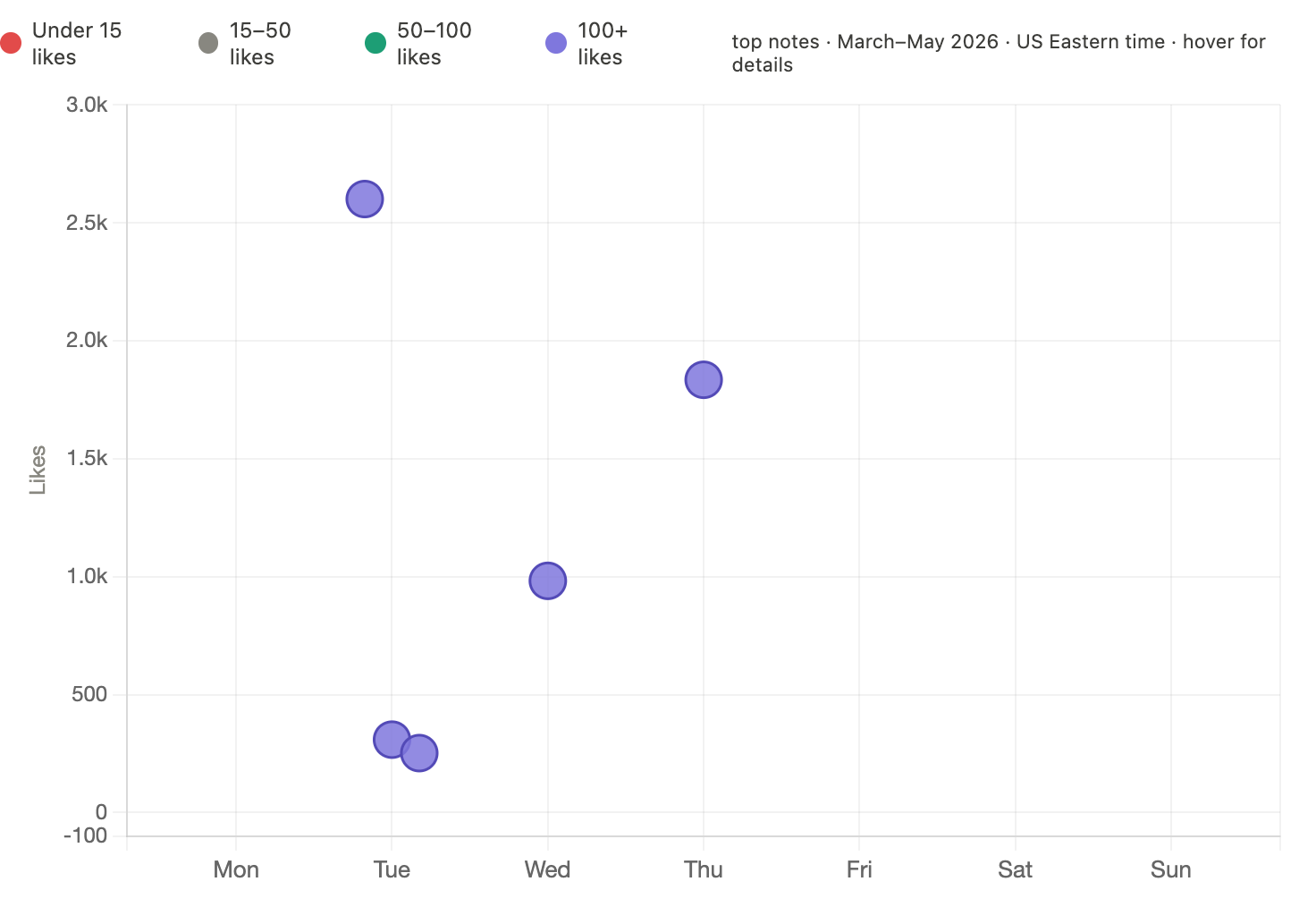
Tuesday has three dots — all three clustered at different heights (2,600 / 309 / 252), making it by far my strongest day across this three months period. Three out of my top 5 notes were published on a Tuesday. Thursday and Wednesday each claim one spot. Monday, Friday, Saturday, and Sunday have no top performers at all.
That said, not every Tuesday note performs well. I had some underperformers on a Tuesday across both months. The day gives you a better window, not a guarantee.

Wednesday and Thursday Are Quietly Strong
Wednesday morning is my second-best slot. One of my highest-engagement notes — 982 likes, with strong comment sections — was published on Wednesday.
Thursday is still reliably solid. If you’re building a 3–4 day posting rhythm, Tuesday, Wednesday, and Thursday form a strong core.
My Notes Performance by Day of the Week — April & May 2026
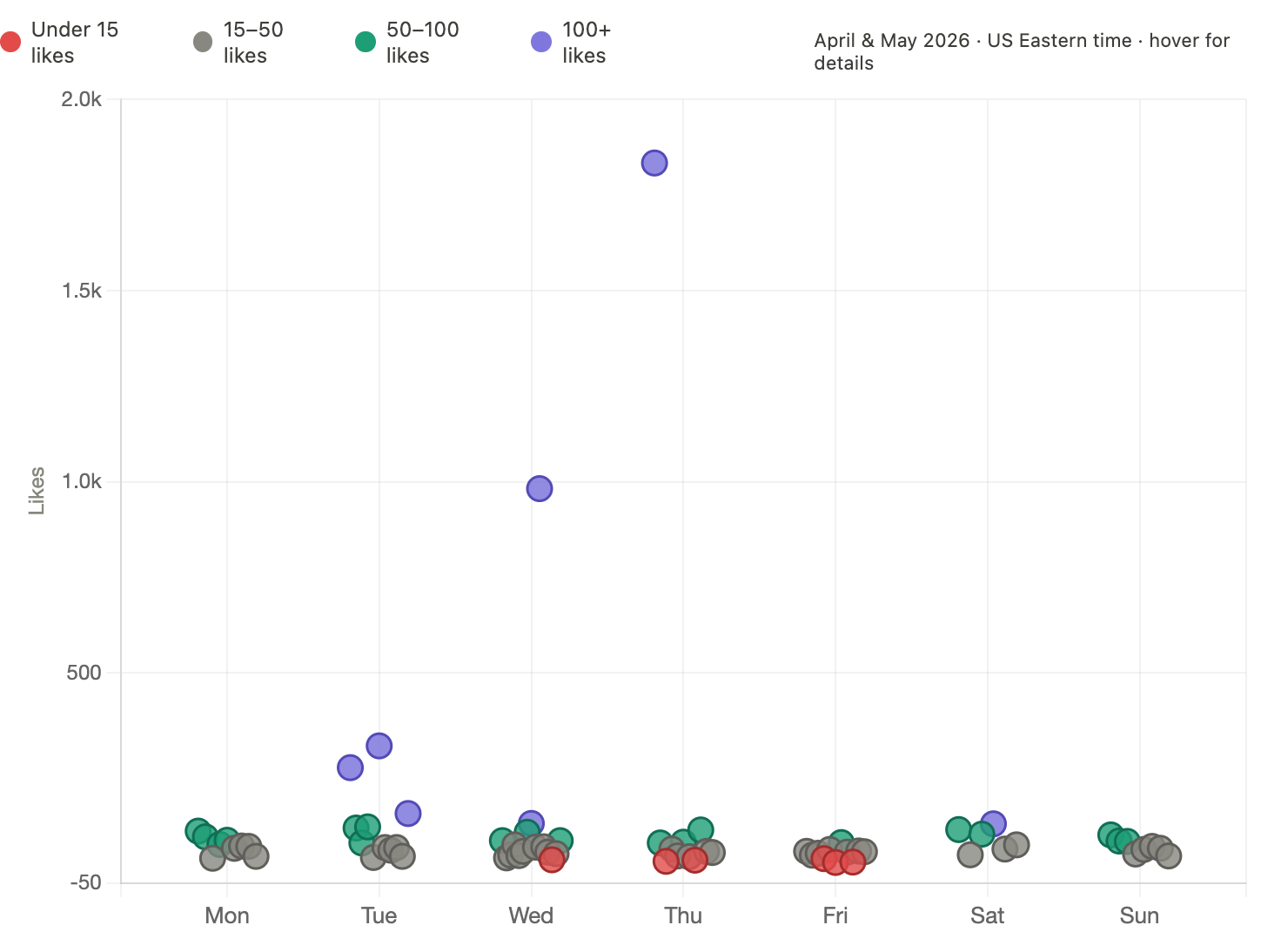
This chart shows all the notes I published on Substack in April and May 2026, organized by day of the week. Each dot is one note. The higher the dot, the more likes it got — the numbers on the left show the amount of likes.
The color tells you which likes range the note falls into:
🔴 Red — under 15 likes
⚫ Grey — 15 to 50 likes
🟢 Green — 50 to 100 likes
🟣 Purple — more than 100 likes
You Can Skip Friday. Seriously.
Friday was the clearest underperformer in my data. Fewest likes, fewest comments, fewest restacks — consistently.
It has the most red dots of any day — four notes under 15 likes, all on Friday.
My niche is practical and work-oriented, so by Friday people are mentally checked out and not looking to engage with that kind of content. That’s probably the explanation for me.
One surprise: Saturday and Sunday are underrated. I rarely publish then, but the data shows a meaningful portion of my audience is active at that time.
If your niche is lifestyle, wellness, or fiction — Friday might actually work for you. Your audience may actually come to your newsletter on Friday looking to unwind.
But many people go out on Fridays, so it's quite possible that Friday is a low-activity day across all niches — though that would need to be tested.

How To Run This Analysis For Your Own Notes
You can either go off what my analysis found, or run your own based on your notes.
It won't take long.
And you don’t need months of data. Two weeks of consistent daily posting — morning and evening — is enough for a solid first read.
Here’s the full process.
Step 1 — Collect your data
For each note, record (manually or automatically with Claude for Chrome):
Date, day of the week, and time of publication
Number of likes, comments, and restacks
Convert publish times to your audience’s primary timezone if you’re posting from a different one
Step 2 — Run the analysis
Upload your collected data to Claude or ChatGPT and гse whichever prompts work best for you.:
Here’s my notes data — [insert the data or download a file].
Analyze the time, date, and day of the week of these notes — what patterns emerge?
Which days of the week correlate with the highest engagement?
Which time slots perform best — morning, afternoon, or evening in my audience’s timezone? Which days or time slots consistently underperform?
What is my single best day-and-time combination?
Are there any secondary patterns — for example, days that drive more comments than likes?
Based on this analysis, what recommendations would you suggest?
But Timing Alone Won't Grow Your Substack
While the data shows that the day you post does matter, timing alone won't make a weak note go viral.
If you’re serious about growing your Substack and turning your writing into income — you need a notes system that consistently brings in engaged subscribers.
The Substack Notes Engine Playbook gets you there in 30 minutes. It’s a complete beginner’s guide to what notes are and how they work + a pack of AI prompts to help you build a notes system that grows your Substack based on YOUR OWN data.
14 prompts with step-by-step frameworks that will help you quickly identify what works, what doesn’t and how to fix it - in about 30 minutes.
This Playbook is for you:
if you’re just starting your newsletter and want to build the right system from day one;
if you’ve been publishing notes for a while but they’re not getting traction and you can’t figure out why.
No technical skills required. Just the free version of any AI tool: Claude, ChatGPT, or Perplexity.
This AI prompts pack includes:
Instructions How To Collect Data (both manually and automatically)
Prompts for Express Audit why your Notes Aren’t Getting Engagement
Prompts for Competitor Comparison
Deep-Dive Analysis Prompts: A Full Picture of What’s Working and Why
Prompts to Generate Notes from Your Top Patterns
Ready-to-use swipe file with my 30+ best-performing Substack notes, including the notes that each brought me between 100–200 new subscribers, complete with data (impressions, likes, and exactly how many subscribers each one drove).
Here’s what changes on your Substack after you apply this playbook:
Your notes start getting more likes — not occasionally, but consistently, week after week, as you refine your formula based on real data rather than guesswork.
New subscribers arrive from your notes which become your main growth engine.
Your posts get higher open rates — because the readers your notes attract are genuinely interested in what you write, not random passersby.
Comments start appearing under your notes and posts. Real conversations, not silence.
You stop losing subscribers. When your notes speak to the right people, the wrong audience stops subscribing — and the right one stays.
And instead of spending an hour every morning wondering what to write, you sit down with a system, pick a note type, follow the structure, and publish in 15 minutes.
You’ll build your own personalized notes system — one that fits your niche, reflects your creativity, and brings you new subscribers every day.
Right now, you can get The Substack Notes Engine Playbook for $17.
Price goes to $34 on Monday — grab it now.
Dear Substackers — have you ever noticed that the day or time you post makes a difference in how your notes perform? I'm sure I'm not the only one curious about this. Would love to hear what's been working for you.
So interesting! Food for thought when I schedule my notes. Particularly as Tuesday 1030am is Wednesday at 4am for me haha
Thank you so much. I tried finding this information online with no luck. I notice that Friday and Saturday on Substack are a Ghost town.