


We all know that notes are one of the biggest growth drivers on Substack. But which ones actually work and why?
I’ve been on Substack for over a year now, and during that time I’ve tried all kinds of different approaches to posting notes. Some went unnoticed, others unexpectedly got hundreds and even thousands of likes, and some didn’t get tons of likes but helped me connect with amazing writers who we all support each other now.
Every time I posted a note, I had no clue which one would hit. When I had accumulated several successful notes, my old academic instincts kicked in, so I thought - let's do this the scientific way.
Instead of just guessing what worked, I fed my best-performing notes to Claude and asked it to find the patterns.
The results impressed me! Claude is seriously good at analyzing content.
Here’s exactly how I did it, and how you can replicate this process with your own content.

My Experiment: 68 Notes, 1 Clear Question
I gathered my top-performing notes from the past 2 months (March-April 2026):
- Note with 2,8k likes, +284 new subscribers
- Note with 1,8k likes, +106 new subscribers
- Note with 249 likes, +21 new subscribers
- And 16 notes with 90-150 likes, +2-7 new subscribers from each note
I copied all the note texts and stats (how many impressions, likes, and comments each one got, and how many subscribers it brought) and fed them into Claude Sonnet 4.6.
Then asked this simple question:
“Based on these Substack notes, identify three types of high-performing notes”.
You don’t need a paid Claude plan for this. The free version works just fine.
As for collecting your Notes data — you have two options. You can do it manually: copy the text and stats from each Note into a document one by one.
Or you can use Claude for Chrome to pull it all automatically, which saves you a ridiculous amount of time. The catch: Claude for Chrome is a paid-plan feature. If you need the full walkthrough on how to use it for Substack, I cover it in detail in The Substack Notes Engine Playbook (see below).
Pro tip: You can run this analysis in a regular Claude chat — but I’d recommend setting up a Claude Project instead. Create one called something like Substack Notes Data, dump your texts and stats in there, and run the analysis using the prompt above.
You can keep adding to it over time. It becomes a living database for your newsletter — and it’s always two clicks away, unlike random chats buried in your sidebar.
Free plan users get up to 5 Projects. Paid plans are unlimited.
During my academia career, I’ve done text analysis for years, so I had pretty high expectations for how this should be done. I admit, Claude exceeded what I expected.
It didn’t just spit out some templates, it did this really solid analysis of my notes without me even asking for that.
It grouped them into three categories and broke down their structure and key elements. Plus, it identified what factors actually make notes successful.
I’m going to share the full analysis and the three successful note templates below so you can use them too.

3 Types of High-Performing Substack Notes: Claude Analysis
Claude ran the analysis and served up the results as clean, visually polished slides — easy to read, packed with the key stats, and with a short breakdown of what makes each Note type work.
Bonus: It’s easy to copy these slides from Claude into a Substack post.
One thing worth noticing — those short highlighted phrases at the bottom of each slide. Claude nailed the core themes behind every high-performing Note, distilled into just a few words.
Now, none of this is about copying!
If everyone starts writing the same Notes, they’ll stop working. That’s not the point.
The point is understanding why certain Notes land.
The most successful creators don't just post whatever comes to mind. They're strategic about the topics they choose. Because you can't build a newsletter business on luck and random thoughts alone. You need to understand your audience — understand what they care about, what actually makes them stop scrolling and feel something.
And that's what this approach will help you do.
Three Clear Notes Patterns Emerge From The Data
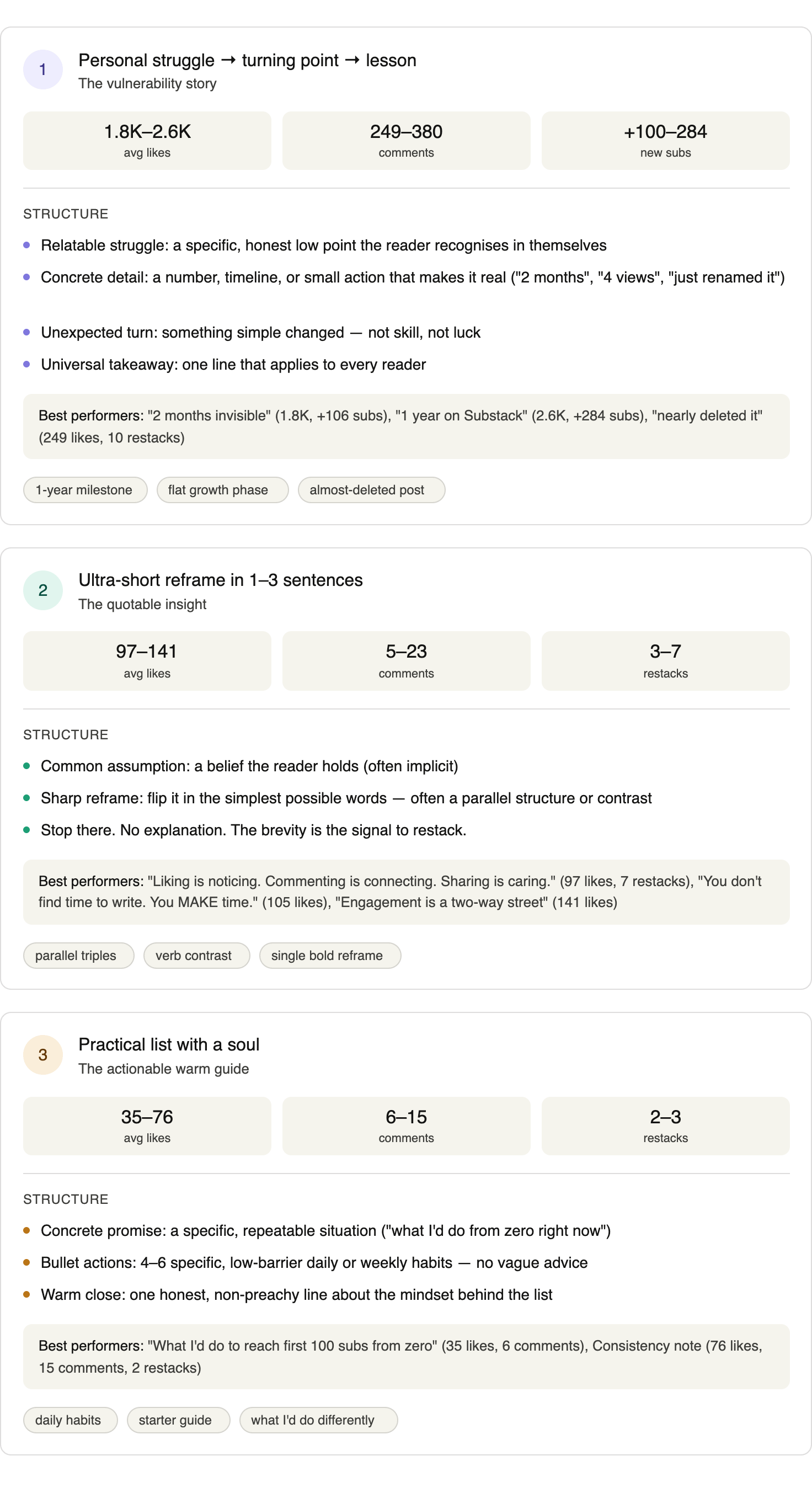
Type 1 — The vulnerability story is by far the most powerful format.
The two biggest Notes ever (2.6K and 1.8K likes, both generating hundreds of new subscribers) follow the exact same arc: name a specific painful low, give it a concrete detail that makes it feel real, reveal a small unexpected turn, then land on a universal line. What makes it work is that there’s no dressing it up — the rawness is the mechanism.
But one thing worth adding. This wasn’t my first Note in the vulnerability story format — but it’s the only one that hit 2.6K likes. That format either explodes (2,600 likes) or lands somewhere in the middle. It's high risk, high reward.
Template 2 — The quotable insight is the restack engine.
Notes like “Liking is noticing. Commenting is connecting. Sharing is caring.” don’t explain anything — they compress a truth into a shape people want to copy. The parallel or contrasting structure does the work.
Template 3 — The actionable warm guide drives the most comments and the most genuine community conversation, even when the raw like numbers are lower. The “what I’d do from zero” Note got 6 meaningful comments and replies precisely because it was specific and honest, not generic. The warm close at the end (“the key is not to rush things”) is what separates it from a plain listicle.
One thing worth noting: the highest-engagement Notes across all three types share one trait — a specific number or concrete detail (“2 months,” “4 views,” “73,000 words”). That specificity is what makes abstract advice feel earned.
Universal Success Factors Across All Templates
Five factors appear in every top-performing note regardless of which template it uses.
Concrete specificity - a real number or detail
Every top note anchors its message in something measurable — a number, a duration, a precise outcome. The specific detail is the proof that earns the reader’s trust and makes an abstract idea feel lived.
The reader sees themselves, not you
The best notes use a personal experience to reflect the reader back to themselves. The story belongs to the writer but the emotion belongs to the reader. The test is whether the reader’s first reaction is recognition, not admiration.
A single unexpected turn
Every top note contains one moment where the expected direction reverses — an assumption flipped, a small action that changes everything, a closing line that reframes the whole. Without this turn the note is a statement. With it, it becomes something worth sharing.
Nothing extra - zero padding
Top notes say one thing and stop at the moment of maximum impact. Every extra sentence added after the natural ending point costs engagement. The notes that underperform often share the same core idea as a top performer but dilute it with an additional explanatory paragraph.
A single idea
Every top note is about one thing, one idea only. The formats allow different amounts of elaboration, but they never mix two separate topics. Where an actionable guide uses multiple points, they are all sub-points of a single central promise — not independent ideas sharing a post.
You can also do this same thing with your own best-performing notes or posts to figure out what works for you and you can apply it to your next pieces so they get seen by your audience too.

How to Replicate This Analysis
Let’s wrap up with a quick recap of how to run this analysis yourself.
Step 1: Gather Your Data
Export your 10-15 best-performing notes. Include:
- The full text
- Like counts
- New subscriber numbers
- Any other engagement metrics
Step 2: Ask AI the Right Questions
Use any of these prompts:
“Based on these Substack notes, identify three types of the most successful notes.”
“What are the common patterns in these successful posts?”
“What tone and language patterns repeat?”
“What structural elements do they share?”
Step 3: Create Your Templates
Ask your AI tool to turn the patterns into fill-in-the-blank templates you can reuse.Example, The Quotable Insight Template:
[Assumed action] is [small true thing]. [Real action] is [bigger true thing].
Step 4: Test and Iterate
Use your templates creatively to write new notes. Track performance. Refine based on what works.
The Next Step: Stop Posting Harder, Start Using a System
If your notes are already working — getting consistent likes, bringing new subscribers every week — you don’t need what I’m about to share.
But if you’ve been posting for weeks or months and your notes are still invisible, the problem isn’t your writing. It’s that you don’t yet have a system built from your own data. And no amount of posting harder will fix a system problem.
That’s why I built The Substack Notes Engine Playbook
- a complete system including 14 AI prompts with step-by-step frameworks for stuck writers who are already showing up but not growing.
It takes exactly what I showed you in this post and goes ten times deeper, using your own data to build a notes system that's specific to your niche, your voice, and your audience.
No technical skills required. Just the free version of any AI tool: Claude, ChatGPT, or Perplexity.
This AI prompts pack includes:
Instructions How To Collect Data (both manually and automatically)
Prompts for Express Audit why your Notes Aren’t Getting Engagement
Prompts for Competitor Comparison
Deep-Dive Analysis Prompts: A Full Picture of What’s Working and Why
Prompts to Build Effective Notes System
Ready-to-use swipe file with my 30+ best-performing Substack notes, including the notes that each brought me between 100–200 new subscribers, complete with data (impressions, likes, and exactly how many subscribers each one drove).
Here’s what changes on your Substack after you apply this playbook:
Your notes start getting more likes — not occasionally, but consistently, week after week, as you refine your formula based on real data rather than guesswork.
New subscribers arrive from your notes which become your main growth engine.
Your posts get higher open rates — because the readers your notes attract are genuinely interested in what you write, not random passersby.
Comments start appearing under your notes and posts. Real conversations, not silence.
You stop losing subscribers. When your notes speak to the right people, the wrong audience stops subscribing — and the right one stays.
And instead of spending an hour every morning wondering what to write, you sit down with a system, pick a note type, follow the structure, and publish in 15 minutes.
You’ll build your own personalized notes system — one that fits your niche, reflects your creativity, and brings you new subscribers every day.
Right now, you can get The Substack Notes Engine Playbook for $17.
The price moves to $34 on Monday — grab it now.
If this post resonated with you, that's your signal.
The Surprising Truth About Viral Content
Being strategic about your notes doesn't mean losing your authenticity or creativity. The actual heart of your notes - your stories, feelings, experiences, your real connection with people.
When I wrote the Notes that ended up getting thousands of likes, I was writing about what I’d actually lived through on Substack. My experience. My feelings. My fails and my wins.
These templates aren’t a formula to copy. They’re a mirror — showing you what’s already landing with your audience, helping you understand your readers better, and giving you a clearer picture of what in your own arsenal actually works. Think of them as prompts: here’s what resonates, now what’s your version of that story?
It’s like the seven basic plots in literature. Every writer knows them. Every writer uses them. And yet no two writers ever produce the same story.
Hope this was helpful! I’ll be happy if you restack or share it with your audience. Really appreciate all the support!
Dear Substackers, have you ever used AI to analyze your content and plan what to publish next? How’s that working out for you? I’d love to hear what you think about it.
Really solid breakdown, especially the way you turned raw performance data into actual repeatable content systems instead of just “AI summaries.”
Also interesting how consistently the same 3 ingredients show up across most viral Substack content:
specificity (numbers, real outcomes)
tension/reversal (expectation vs reality)
compression (one idea, no extra noise)
That combination is basically what makes something “saveable” instead of just “readable.”
Curious, did you notice any patterns in failed Notes as well, or was the analysis mainly focused on winners?
This is a helpful post. I appreciate our work and the insights you got from it. I hope it continues to make you successful, and that a little of it will rub off onto some folks like me (and your other readers) Kudos!